Friday, March 27, 2015

LYNCH ADMITS SHE HAD WHISTLEBLOWER'S EVIDENCE ON BANKSTERS

from wnd.com


author-imageJEROME R. CORSI About | Email | Archive


Loretta Lynch is sworn in before testifing during her confirmation hearing before the Senate Judiciary Committee Jan. 28.
Loretta Lynch is sworn in before testifying during her confirmation hearing before the Senate Judiciary Committee Jan. 28.
NEW YORK – President Obama’s attorney-general nominee, Loretta Lynch, admitted to the Senate Judiciary Committee that her investigators in the money-laundering probe of HSBC were aware of evidence compiled by whistleblower John Cruz but she chose, nevertheless, not to bring criminal charges.
Lynch provided written answers to questions submitted by committee chairman Sen. Charles Grassley, R-Iowa, in a document posted on the panel’s website dated Feb. 18.
As WND reported, Lynch’s confirmation vote in the Senate initially was postponed after Sen. David Vitter, R-La., a member of the Senate Judiciary Committee, opened the investigation of Lynch’s role in the HSBC deferred prosecution after his staff quizzed Cruz, a former HSBC employee-turned-whistleblower whose trove of original evidence of money laundering was reported first by WND.
Cruz charged HSBC was engaged in a willful, criminal scheme to launder money for Mexican drug cartels and Middle East terrorists.
In response to Grassley, Lynch, as U.S. attorney for the Eastern District of New York, acknowledged Department of Justice “investigators did speak with and receive documents and information from Mr. Cruz.”
“Based on the in formation he provided, we took appropriate additional investigative steps, including requiring additional information from HSBC,” she replied to the senator.
“Investigators carefully considered the information he provided as we considered whether there was sufficient admissible evidence to prosecute violations at HSBC and whether any such prosecution otherwise would have been consistent with the principles of federal prosecution contained in the United States Attorney’s Manual,” said Lynch.
“Ultimately, HSBC entered into a DPA that required remarkable reforms based on Bank Secrecy Act and sanctions violations, and that explicitly provides no protection from prosecution for conduct outside of the Statement of Facts.
In the deferred prosecution agreement, or DPA, HSBC agreed to pay $1.9 billion in fines and make structural changes as a condition of not pressing criminal charges.
Lynch repeatedly emphasized, however, the DOJ settlement with HSBC was limited to criminal violations of the Bank Secrecy Act.
“Note that we did not charge HSBC with money laundering,” Lynch told the Senate Judiciary Committee. “Rather, HSBC’s failure to maintain an effective anti-money laundering program violated the Bank Secrecy Act by creating a corporate environment that failed to stop others from laundering money through HSBC.”
Grassley noted Cruz spoke with IRS criminal investigators in Colorado in early 2012 and provided approximately 1,000 pages of documents and 30 hours of audio recordings to the IRS and the Securities and Exchange Commission in whistleblower submissions in July 2012.
Grassley also pointed out that Cruz provided the material to the Department of Justice in September 2012, more than two months before Lynch’s office filed the deferred prosecution agreement Dec. 11, 2012.
Grassley asserted the Cruz documents “suggest the extent of HSBC’s criminal conduct may not have been fully described in the Statement of Facts associated with the [deferred prosecution agreement] reached with the government.”
When initially asked by Grassley if HSBC provided any of the Cruz documents to the Department of Justice, Lynch answered: “I understand that investigators spoke with and received documents from Mr. Cruz, and after speaking with Mr. Cruz, required information from HSBC; I am not aware at this time whether HSBC then supplied documents identical to those that Mr. Cruz had supplied.”
Grassley then asked, if HSBC did provide the Cruz documents to the DOJ, why was the criminal money-laundering scheme Cruz exposed not included in the HSBC Statement of Facts or used as the basis for criminal prosecutions.
“Investigators considered the information and documents provided by Mr. Cruz, and took appropriate additional investigative steps,” Lynch responded. “I should reiterate, however, that the DPA reached with HSBC in 2012 addressed only the charges filed in the criminal information, which are limited to violations of the Bank Secrecy Act for failure to maintain an adequate anti-money laundering program and sanctions violations.”
Lynch emphasized there was nothing in the DPA that would prevent subsequent prosecution of HSBC employees for criminal money-laundering.
WND exposed HSBC money laundering
Breaking the story on Feb. 1, 2012, WND reported Cruz delivered to WND approximately 1,000 pages of customer account records he pulled from the HSBC computer system before he was fired by senior management, who had no interest in investigating his claim to have discovered illegal money-laundering activity at the bank.
Cruz began working at HSBC Jan. 14, 2008, and was terminated for “poor job performance” Feb. 17, 2010.
In his position as an account relationship manager, Cruz worked in the HSBC southern New York region, which accounts for about half of HSBC’s North American revenue. He was assigned to work with several branch managers to identify accounts where HSBC might introduce additional banking services.
“The Obama administration is continuing to cover up its role in the HSBC money laundering scandal,” Cruz told WND in a telephone interview Thursday.
“The IRS has blocked every legal effort I have made to be credited as a whistleblower in the HSBC billion-dollar settlement,” Cruz said. “It is impossible that the Obama administration did not know HSBC was laundering drug money for the Mexican cartels, because the documentation I had showed the laundered money passed through the federal wire-transfer services.”
HSBC a ‘criminal enterprise’
As WND reported in May 2012, Cruz charged that HSBC was a “criminal organization” involved in a “culture of crime.”
“Money comes in daily, thousands of dollars, always in even amounts,” he said. “You look at a statement and it says ‘transfer,’ but where did it go? There’s no account number or tracking number that documents where the transaction went.”
Cruz contended that HSBC was running what amounted to a “shell game.”
“So many of these businesses are conducted out of a person’s home,” he said. “I would walk into these homes. There’s a couch, there’s a chair, a desk, but the house is empty – a couple of Mercedes sitting out front – but where is the business? It’s only online transactions of money-in and money-out.”
Identity theft
To implement the money-laundering scheme, Cruz charged the 1,000 pages of customer account records suggest HSBC relies on identity theft to capture legitimate Social Security numbers to create bogus retail and commercial bank accounts. Through the accounts, HSBC employees systematically deposited and withdrew hundreds of millions of dollars on a daily basis, apparently without the knowledge of the identity theft victims.
“When an individual finds out they got a loan they never knew about, 5 percent of that loan went to the accounting firm that made up the phony tax returns and the other 95 percent of that loan went to the manager,” he charged.
“One manager was involved in the transaction, another manager was involved in notarizing the transaction, and senior management was involved where they signed off permission to give the loans even when the loans get rejected by underwriting.”
On July 17, 2012, the Senate Permanent Subcommittee on Investigations, released a majority and minority 330-page staff report titled “U.S. Vulnerabilities to Money Laundering, Drugs, and Terrorist Financing: HSBC Case History.” It documented HSBC’s role in illegally laundering drug money for Mexican cartels Middle Eastern terrorists.
“In an age of international terrorism, drug violence in our streets and on our borders, and organized crime, stopping illicit money flows that support those atrocities is a national security imperative,” said Sen. Carl Levin, D-Mich., the chairman of the Senate Permanent Subcommittee on Investigations, upon the release of the report.
“HSBC used its U.S. bank as a gateway into the U.S. financial system for some HSBC affiliates around the world to provide U.S. dollar services to clients while playing fast and loose with U.S. banking rules,” Levin continued. “Due to poor AML [Anti-Money Laundering] controls, HBUS exposed the United States to Mexican drug money, suspicious travelers cheques, bearer share corporations, and rogue jurisdictions. The bank’s federal bank regulator, the OCC, tolerated HSBC’s weak AML system for years. If an international bank won’t police its own affiliates to stop illicit money, the regulatory agencies should consider whether to revoke the charter of the U.S. bank being used to aid and abet that illicit money.”
Vitter delays Lynch nomination
On Feb. 11, WND reported Sen. David Vitter, R-La., a member of the Senate Judiciary Committee, delayed the Lynch nomination by announcing he had decided to investigate Lynch’s decision not to prosecute HSBC.
Vitter’s Washington staff quizzed Cruz in an hour-long teleconference that WND attended during which Vitter’s staff questioned Cruz over his allegations and his evidence. Vitter’s staff left the meeting asking, “How can we allow Loretta Lynch to be the nation’s top federal law enforcement officer when the HSBC money-laundering scandal raises questions about a cover-up scandal that may be continuing even today?”
On Wednesday, Rep. Emanuel Cleaver, D-Mo., charged that the opposition of Senate Republicans to the Lynch nomination is rooted in racism.
Cleaver told Bloomberg Politics that failure to confirm Lynch would be further evidence race relations in the United States have deteriorated as Senate Republicans square off against the first black president, rejecting his first-ever nomination of a black woman to be attorney general.
“It would be yet another sign that the chasm we thought was narrowing is in fact just as it was before we entered into this new millennium as it relates to issues of race,” Cleaver said. “For many minorities, Latinos and African-Americans, it would be just another contemporary sign that we have not moved as far as we had hoped.”
A Rasmussen poll released this week showed only 33 percent of likely U.S. voters believe the Senate should confirm Lynch to replace Eric Holder.
The survey found that 40 percent remain undecided, comprising a majority when added to the 27 percent of likely voters who oppose Lynch’s confirmation.
A Senate vote on the Lynch nomination is not expected now until mid-April.
WND reported Monday Senate Majority Leader Mitch McConnell’s office confirmed the Senate has once again postponed the vote on Lynch’s nomination.
McConnell, R-Ky., said in a CNN interview Sunday he won’t hold a confirmation vote for Lynch before the Senate completes its work on a human-trafficking bill.
The majority leader’s further delay the Lynch confirmation vote is widely viewed by Washington insiders as a Republican rebuke to President Obama’s controversial executive actions, including de facto amnesty for up to 5 million illegal aliens. Also, the Obama administration has refused to acknowledge a legitimate role for Senate consideration of any agreement Secretary of State John Kerry may conclude with Iran in the current round of negotiations in Geneva over Tehran’s nuclear program.
On Tuesday, NorthJersey.com reported Sen. Bob Menendez, D-N.J., may be the key to Lynch’s nomination as attorney general.
The New Jersey newspaper reported an ethics expert maintained it would not be a conflict of interest for Menendez to cast the deciding vote, even as the senator expects the Department of Justice to hand down an indictment for alleged corruption.

Thursday, March 26, 2015

Review: Cartel funded sex parties of DEA agents

from usatoday


 Kevin Johnson, USA TODAY4:30 p.m. EDT March 26, 2015

DOJ logo

WASHINGTON — For years, Drug Enforcement Administration agents posted in Colombia engaged in sex parties involving prostitutes who were supplied by local drug cartels, a Justice Department review found Thursday.
The Justice inspector general's inquiry, which examined how federal law enforcement agencies handled sexual misconduct and harassment reports, concluded that seven of 10 agents allegedly involved admitted attending the parties in Colombia where a local police officer often stood guard, protecting the agents' firearms and other property.
In addition, the report found, three of the DEA agents — all described as supervisory special agents — were "provided money, expensive gifts and weapons from drug cartel members.''
Although the misconduct jeopardized the agents' security clearances, the matter was never referred to the agency's Office of Security Programs for review, and the agents were issued suspensions ranging from two to 10 days.
"Most of the sex parties occurred in government-leased quarters where agents' laptops, BlackBerry devices and other government issued equipment were present ... potentially exposing them to extortion, blackmail or coercion,'' the report said.
Some of the DEA agents involved in the misconduct, the inspector general found, also were involved in investigations of two former Colombian police officers who initially provided information about the sex parties to DEA officials.
"If these special agents had served as government witnesses at the trials of these defendants, their alleged misconduct would have had to be disclosed to defense attorneys and would likely have significantly impaired ability to testify at trial,'' the report concluded. A trial was avoided, however, when the suspects struck plea agreements in a narcotics conspiracy case.
DEA supervisors also failed to initiate formal internal investigations into the activities of two agents who were subjects of repeated allegations of patronizing prostitutes and frequenting a brothel, the inspector general's report found.
One of the two agents who were the focus of the allegations also was alleged to have assaulted a prostitute during a payment dispute.
The Justice inspector general's review found that the agents' misconduct was ultimately reported to the agency's Office of Professional Responsibility (OPR) in 2010 via an anonymous letter.
Though a subsequent OPR review found that the agents' supervisors were aware of at least four complaints involving loud parties attended by prostitutes in a government-leased apartment from 2005 to 2008, the managers never forwarded those allegations for investigation by the OPR.
In all, the inspector general's report found, federal law enforcement agencies were linked to 26 allegations involving the solicitation of prostitutes abroad during a four-year review ending in 2012. Of that total, the DEA was involved in 19 such alleged offenses.
Though the inspector general's review focused on allegations raised from 2008 to 2012, the findings raised new concerns about the conduct of federal law enforcement officers assigned to missions outside the U.S.
In 2012, U.S. Secret Service agents preparing for the arrival of President Obama in Cartagena, Colombia, were swept up in a sex scandal when agents brought several prostitutes back to their hotel. Authorities were only alerted to the incident at the Hotel Caribe when one of the agents became involved in a dispute over payment to one of the women.
The incident resulted in agent dismissals and inquiries by congressional committees, one of which promised a separate investigation into the allegations involving the DEA.
Rep. Jason Chaffetz, R-Utah, chairman of the House Oversight and Government Reform Committee, described the inspector general's findings as "truly stunning.''
"Let there be no mistake, this is a national security threat,'' Chaffetz said in a written statement. "We need to hold them accountable, and given the clear evidence in the OIG report, they should be fired immediately.''
DEA officials declined comment Thursday. But in a letter to the inspector general, Michael Dixon, the DEA's acting deputy chief inspector, said the report focused on just 3% of cases that the agency could have investigated "more thoroughly.''
Dixon noted that in October the agency issued a memorandum intended to "address specific areas of misconduct where the violations can seriously impact the integrity of the DEA.''
The memo, as outlined in Dixon's letter, addressed such things as off-duty conduct, sexual harassment, improper relationships with sources and other issues.
"DEA believes this memorandum ensures that supervisors and managers, as well as employees are aware of their responsibilities concerning misconduct and that appropriate measures through the disciplinary process will be taken once a report of misconduct is received.''

GOP blocks Warren's student loan plan

from thehill.com


5.3K2.1K
 493
Senate Republicans on Wednesday blocked an effort by Sen. Elizabeth Warren (D-Mass.) to attach an amendment aimed at lowering student loan rates to the budget.
 
Senators voted 46-53 against Warren's amendment to the Republican budget resolution. 
 
Warren's amendment would have allowed people with college loan debt to refinance at interest rates from the 2013-2014 academic year. The Massachusetts Democrat, who is rejecting calls to run for president, said the move would allow undergraduates to refinance their loans to a 3.9 percent interest rate, with a "slightly higher" rate for graduate students. 
 
"Millions of borrowers are still stuck paying interest rates at 6 percent, 8 percent, 10 percent and even higher," she said.
 
Her plan would have been paid for by requiring millionaires to pay at least a 30 percent effective federal tax rate. 
 
"The amendment would save borrowers hundreds, if not thousands," Warren said. "We have a choice: protect a tax loophole for billionaires or give millions of middle class people a chance to build some real economic security. ... Congress has worked too long for the billionaires" 
 
Wednesday's vote isn't the first time Republicans have stopped Warren's student loan efforts. Sen. John Cornyn (R-Texas) blocked a bill from being brought up last year, unless the Massachusetts Democrat agreed to unlimited amendments. 
 
Warren said Wednesday that, because of the Republicans' decision, the "student debt problem got worse, much worse." 
 
"Last year, Republicans blocked our efforts to lower student loan interest rates ... so tens of millions of borrowers got nothing," she said ahead of the vote. "While Republicans were busy blocking student loan refinancing, our country's student debt problem got worse, much worse." 
  
Sen. Mike Enzi (R-Wyo.) urged his colleagues to vote against Warren's amendment. The Budget Committee chairman said something has to be done on student loan debt but said the budget resolution wasn't the place for it.
 
"Addressing college costs and the burden of high student debt loans has to be done, but it can't be done on a budget bill," he said ahead of the vote. "You can't have policy on a budget resolution." 
 
Senators passed by voice vote a separate student-loan related amendment. The amendment, by Sen. Richard Burr (R-N.C.), aims to simplify loan repayment by reducing overlapping programs.


Who was Germanwings co-pilot suspected of deliberately crashing plane?

from cnn


Story highlights

  • Pilot who knew co-pilot Andreas Lubitz called him a "very nice young man"
  • Captain locked out of cockpit; co-pilot apparently deliberately crashed Germanwings plane
  • Lubitz was 28-year-old German national, said Marseille prosecutor
(CNN)Details are slowly emerging Thursday about a 28-year-old German national who officials believe purposely crashed Germanwings Flight 9525.
Andreas Lubitz was alone at the controls of the Airbus A320, officials said -- and died along with all 144 passengers and five fellow crew members -- when it plunged into the French Alps Tuesday.
It seems that Lubitz "wanted to destroy the aircraft," Marseille prosecutor Brice Robin said, but it's unclear why.
Information gleaned from the aircraft's mangled cockpit voice recorder revealed that the captain, who has not been identified, left the cockpit, probably to use the restroom, the prosecutor said.
When the captain returned, he couldn't get back inside. He banged on the door but Lubitz did not open the door, Robin said.
The co-pilot "manipulated the buttons of the flight monitoring system to activate the descent of the aircraft," Robin said. "The action can only be voluntary."
    Robin doesn't know if the co-pilot planned in advance, but that Lubitz "took advantage" of the captain leaving the cockpit to begin the aircraft's descent.
    The recorder captured a horrific soundtrack. One can hear the captain banging on the door, Robin said.
    At one point, the captain used a video conference system to talk to the co-pilot, the prosecutor said. That system would have allowed the co-pilot to see and hear the captain demanding to get inside the cockpit, aviation experts say.
    Passengers were apparently unaware of what was happening until the last few moments when screams were heard on the recording.
    Lubitz said nothing as the plane fell, the prosecutor said.
    But the sound of Lubitz breathing steadily is heard.
    There's no indication that the co-pilot became physically ill or suffered a stroke, the prosecutor said, and Lubitz seemed to be alive until the plane crashed into the mountains.
    Reporters asked Robin if he viewed the co-pilot's actions as a suicide.
    "When you are responsible for 150 people, I don't call it a suicide," he answered.

    The biggest question: Why?

    There's no reason to believe, at this time, that Lubitz's motives were terrorism-related, the prosecutor said. His name wasn't on any terror list.
    Lubitz had been with Germanwings since September 2013 and had completed 630 hours of flight time, the Germanwings media office said.
    Lufthansa, the owner of Germanwings, does "not have any clues" about why the co-pilot crashed the plane, Lufthansa CEO Carsten Spohr said Thursday.
    Spohr echoed the French prosecutor's sentiments regarding the term "suicide."
    "If a person kills himself and also 149 other people, another word should be used -- not suicide," he said.
    He gave details about Lufthansa pilot training after mentioning that Lubitz "interrupted" his training, which he began in 2008. That break lasted several months, he said, but such an interruption isn't uncommon.
    Spohr said he couldn't give any information about why the co-pilot had stopped and then restarted his training.
    If it was for medical reasons, he said, then that information would have been private before the crash, he said, but it will be part of information gathered during the investigation.
    Pilots in the Lufthansa group get medical testing, but not psychological testing, Spohr said.
    Lubitz had trained at the Lufthansa flight training center in Bremen, Germany.
    "He was 100% set to fly without restrictions," said Spohr. "His flight performance was perfect. There was nothing to worry about."

    'A very nice young man'

    Pilot Peter Ruecker said he knew Lubitz.
    Ruecker is a longtime member of the flight club in the German town of Montabaur where Lubitz flew, Reuters reported.
    "Andreas was a very nice young man who got his training here and was a member of the club," Ruecker told the news agency. "He was a lot of fun, even though he was perhaps sometimes a bit quiet. He was just another boy like so many others here. ... I think he had a lot of fun here."
    Hearing about the likelihood that Lubitz intentionally crashed the Germanwings flight, Ruecker said, "I'm just speechless. I cannot give you any explanation for that. Knowing Andreas, this is just inconceivable for me."
    Another pilot, Klaus Radke, told Reuters that he interacted with Lubitz last fall when Lubitz performed flights to maintain his license.
    "I got to know him, or I should say reacquainted with him, as a very nice and a lot of fun, and a polite young man," Radke said.
    He said he couldn't fathom that Lubitz intentionally downed Flight 9525.
    "I can't imagine it, I just can't imagine it," he said. "I just think, you know, whatever (happened), they are professional pilots. They have a certain internal control mechanism. They are examined, they have to be healthy and everything."
    "It's all unimaginable, what's being suspected here," he said. "So my request is that people take the time before they jump to any conclusions. That's what human empathy requires."

    CEO: Captain acted properly

    As for the captain of the flight, he didn't leave the cockpit to use the restroom until the plane reached cruising altitude, which suggested he acted properly, Spohr explained.
    The captain informed the co-pilot that he was stepping out and that the co-pilot had control of the plane, the CEO said.
    He added that the flight crew who were outside the cockpit could not have activated a distress signal. A distress signal can be activated only from the cockpit, he said.

    'Instantaneous' death

    Death was "instantaneous" for the 150 people from 18 countries on board, Robin said.
    Spohr said that Lufthansa is providing financial assistance to the families of those who perished.
    The co-pilot's family has arrived in France, Robin said.
    It's likely that German authorities will interview them first, the prosecutor said, and then French authorities will talk to them.
    German Transportation Minister Alexander Dobrindt spoke briefly at a news conference after Robin's.
    He said that it is "plausible to us" that the plane was deliberately crashed.
    Reports about the co-pilot locking the captain out first emerged early Thursday.
    "You can hear he is trying to smash the door down," a senior French military official involved in the crash investigation told The New York Times.
    "We don't know yet the reason why one of the guys went out. But what is sure is that at the very end of the flight, the other pilot is alone and does not open the door."
    The flight was traveling from Barcelona, Spain, to Dusseldorf, Germany.
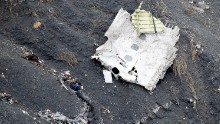
    Investigators are combing through the debris -- scattered across a steep, icy mountainside -- for clues.
    They also want to find the plane's second "black box," the flight data recorder.